Alpine glaciers are Europe’s “water towers”. They store snow in winter and release it slowly during summer, keeping crucial rivers — such as the Rhine, Rhone, and Danube — navigable and full.
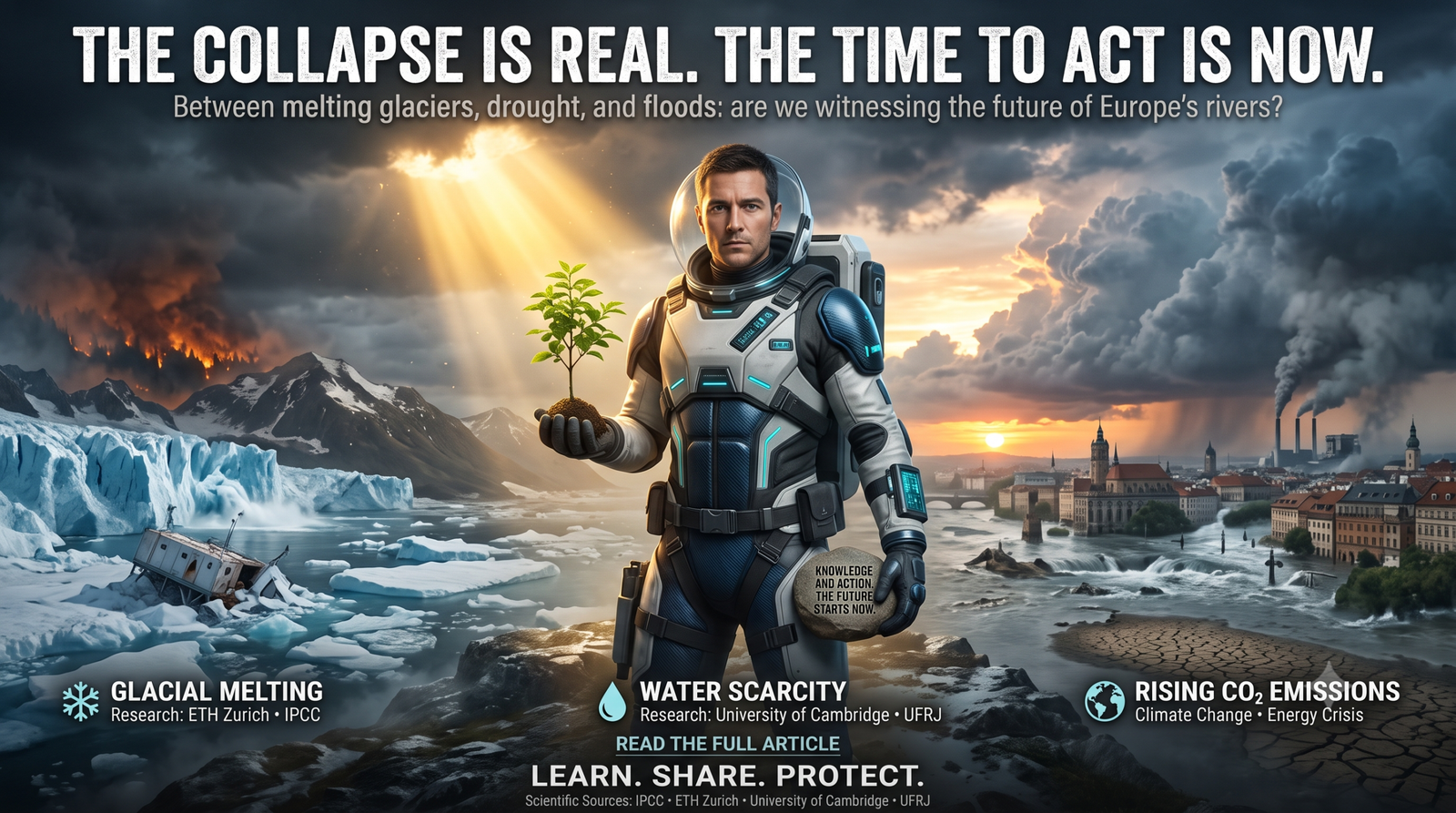
Researchers from ETH Zurich, led by experts like Daniel Farinotti and Lukas Gudmundsson, have reached alarming conclusions. They created the concept of “Peak Glacier Extinction” (the moment when annual ice loss reaches its maximum).
- Optimistic Scenario (+1.5°C): The peak loss will occur around 2041. In the Alps, only 12% of current glaciers (about 430) will survive until 2100.
- Pessimistic Scenario (+4.0°C): The peak shifts to 2055, but the loss is much more severe. Only 1% of the Alps’ glaciers (about 20) will remain by 2100.
- Most Affected Regions: Cities along the Rhine and Po basins in northern Italy will suffer from the collapse of river transport, water shortages for cooling nuclear power plants, and severe agricultural crises. If all glaciers melt, at the peak of summer, European rivers could reach historically low levels, paralyzing the local economy.
Visual Note: The severe reduction of glaciers is already being documented.
Link: https://www.dlr.de/en/latest/news/2025/glacial-melting-increases-freshwater-loss-and-accelerates-sea-level-riseDaniel Farinotti : https://www.esa.int/esatv/Videos/2021/09/Glaciers_and_climate_change/Soundbites_Daniel_Farinotti_Glaciologist_ETH_Zurich_-_German
Lukas Gudmundsson: https://usys.ethz.ch/personen/profil.lukas-gudmundsson.html
The Ripple Effect: Oceans, El Niño, and Global Research
While the mountains dry up, the sea advances. Institutions like UFRJ (whose researchers collaborate intensely with IPCC reports, such as Prof. Michael Oppenheimer from Princeton) and Cambridge University study the global consequences of this thaw.
About 60% of current sea-level rise comes from the melting of glaciers and polar ice caps (Antarctica and Greenland), while the other 30% comes from thermal expansion (warm water takes up more physical space).
What About El Niño?
El Niño (anomalous warming of the Pacific Ocean) acts as a temporary amplifier. It causes rapid and extreme fluctuations in the climate. During El Niño years, oceans absorb more heat, tropical rainfall patterns change, and the global sea level undergoes rapid, localized jumps, intensifying coastal storms. Coastal cities like Venice, Amsterdam, and London are at extreme risk of combined flooding (high tide + stronger storms).
The Effect of the War and the Carbon Crisis
Russia’s invasion of Ukraine in 2022 added fuel to the climate fire. When Russia cut off natural gas supplies to Europe, the continent faced an energy sovereignty crisis.
| The Impact of War | Climate and Economic Consequence |
| Return to Coal | To avoid blackouts and supply the lack of gas in the short term, countries delayed the closure of coal power plants and expanded the purchase of LNG (Liquefied Natural Gas). |
| Direct Emissions | Research indicates that the first 4 years of war generated about 311 million tons of CO2, equivalent to the annual emissions of a country like France. |
| Reconstruction | It is estimated that over 80% of future emissions from the conflict will come from rebuilding Ukrainian cities with carbon-intensive materials like steel and cement. |
How is Europe Adapting?
Faced with this scenario of natural disasters (extreme summer droughts, devastating winter floods, and food inflation), Europe is studying and implementing drastic solutions:
- Ecosystem-Based Adaptation: Restoration of natural floodplains to absorb excess water in winter and release it in summer.
- Mandatory Energy Efficiency: Massive subsidies for home thermal insulation and heat pump installation, reducing dependence on gas.
- Managed Retreat: In some coastal areas, governments are accepting that building higher dikes is not sustainable in the long term, opting to move entire communities inland.
What Can We Do Daily?
Reversing this process requires political pressure and systemic change, but ecological awareness begins in daily choices of survival and consumption:
- Change your mobility: Swapping a private car for public transport or a bicycle drastically reduces your personal carbon footprint.
- Domestic efficiency: Reduce energy waste. Efficient appliances, shorter showers, and thermal insulation (even simple ones) make a difference.
- Conscious consumption: Reduce meat consumption (especially beef, highly associated with deforestation and methane emissions) and value local products, reducing transport emissions.
- Exert pressure: Vote and demand public policies that subsidize clean energy and punish environmental destruction. Global warming is, above all, a political problem.
What are the 5 socioeconomic and climate scenarios predicted by the IPCC (SSPs) and how do they affect our future up to 2100?
The Intergovernmental Panel on Climate Change (IPCC), in its Sixth Assessment Report (AR6), updated the predictions for humanity’s future using the so-called SSPs (Shared Socioeconomic Pathways).
Unlike older metrics that only measured carbon emissions, SSPs combine the amount of greenhouse gases with how society will behave (politics, economy, technology, education, and consumption) up to the year 2100.
They are divided into 5 main narratives. Think of them as 5 “possible endings” for our century:
1. SSP1: Sustainability (“The Green Road”)
What it is: The most optimistic scenario. The world shifts gradually, but profoundly, toward sustainable development. The focus shifts from economic growth at all costs to human well-being.
Society: Inequalities decrease (both between and within countries). There is heavy investment in education and health. Consumption is conscious and geared toward low resource and energy intensity.
Climate up to 2100 (SSP1-1.9 and SSP1-2.6): It is the only path that keeps us close to or below the 1.5°C to 2°C warming limit stipulated in the Paris Agreement. Net CO2 emissions reach zero around 2050. Mitigation and adaptation challenges are low.
2. SSP2: Middle of the Road
What it is: The world follows current historical trends. Things don’t drastically improve, nor do they completely worsen.
Society: Development and income growth happen unevenly — some countries progress well, others fall behind. There is some progress toward sustainable development goals, but it is slow. Population growth is moderate and stabilizes in the second half of the century.
Climate up to 2100 (SSP2-4.5): Global warming reaches near 3°C (likely between 2.7°C and 3.4°C). Environmental degradation continues, albeit with some improvements in energy efficiency. Represents moderate mitigation and adaptation challenges.
3. SSP3: Regional Rivalry (“A Rocky Road”)
What it is: A world fragmented by nationalism. Countries close their borders and focus only on their own security and survival.
Society: Resurgence of nationalism and regional conflicts. The priority is the energy and food security of each nation, sacrificing global development. Investments in education and technology plummet. Inequality and poverty worsen. Population grows rapidly in developing countries and falls in industrialized ones.
Climate up to 2100 (SSP3-7.0): Without international cooperation, environmental policies are abandoned. The use of polluting fuels explodes and deforestation accelerates. Warming exceeds 3.5°C or 4°C, causing drastic environmental damage in several regions. Enormous challenges to reduce emissions and also to adapt.
4. SSP4: Inequality (“A Divided Road”)
What it is: A hyper-divided world. The global elite (political and economic) isolates itself and cooperates with each other, while the rest of the population stagnates in poverty.
Society: The gap between rich and poor widens immensely. A small part of the world has access to advanced technology and capital, while the rest suffers from low development and lack of education.
Climate up to 2100: The result is mixed. Elites manage to implement clean technologies for themselves and solve local environmental problems (like air pollution in rich metropolises). However, the global abandonment of vulnerable populations makes it difficult to adapt to climate change in poorer regions.
5. SSP5: Fossil-Fueled Development (“Taking the Highway”)
What it is: The “growth at all costs” scenario using oil, coal, and gas. The focus is getting rich quick and fixing the environment later with technology.
Society: Global markets are highly integrated, there is strong technological progress, eradication of extreme poverty, high education, and strong economic growth. The problem: all this is driven by massive burning of fossil fuels and a lifestyle of very high material and energy consumption.
Climate up to 2100 (SSP5-8.5): It is the worst warming scenario. Because there is a lot of money and technology, humanity manages to deal with storms and scarcity (few adaptation challenges), but the climate collapses, with warming that could hit 5°C. Sea levels rise extremely. It is a dangerous bet that we will be able to “buy” our salvation from natural disasters.
In summary: Our future up to 2100 (whether we keep the rivers full, coastal cities safe, and agriculture functional) does not depend only on building solar panels. It depends on the social path we choose: SSP1 shows that the only way to stabilize the climate is by combining emission reductions with combating inequality and changing consumption patterns.